


Choosing the wrong wire cloth mesh count costs more than the mesh itself. It costs downtime, failed batches, and re-specification cycles that push projects back weeks. This guide walks through the six decisions that determine the right mesh count for a filtration application, from particle retention requirements to ASTM E2016 verification, based on what we have learned weaving wire cloth since 1914.
Mesh count is the primary specification variable for woven wire cloth used in filtration, separation, and screening applications. Defined by ASTM E2016 (Standard Specification for Industrial Woven Wire Cloth), mesh count refers to the number of openings per linear inch, measured center-to-center from one wire to a point one inch distant. A 100-mesh cloth has 100 openings per linear inch in each direction, producing 10,000 openings per square inch. Higher mesh counts produce finer filtration but reduce flow rate. The actual size of those openings — measured in microns — depends on a second variable: wire diameter. Two cloths with the same mesh count but different wire diameters will have different opening sizes and different particle retention characteristics. Standard industrial wire cloth ranges from 4 mesh (large, structural openings) through 635 mesh (openings below 20 microns), with the 60-to-325-mesh range covering the majority of industrial filtration applications. Cleveland Wire Cloth, an AS 9100D-certified manufacturer weaving wire cloth since 1914, produces filtration media across this range in over 30 alloys.
Request a quote for any mesh count configuration discussed in this guide.
What is mesh count and why does it matter for filtration?
Mesh count defines how many openings exist per linear inch of wire cloth. (“Wire cloth” and “woven wire mesh” are the same product.) It is the starting point for every filtration specification because it sets the scale of particle separation a cloth can achieve.
A 60-mesh cloth has 60 openings per linear inch — relatively large, suited for coarse screening. A 325-mesh cloth has 325 openings per inch, with openings around 44 microns. That is fine enough to retain particles invisible to the naked eye.
The relationship between mesh count and filtration performance is not linear. As mesh count increases:
- – Opening size decreases (finer particle retention)
- – Open area decreases (lower flow capacity)
- – Pressure drop across the media increases
- – Wire diameter must decrease to maintain usable opening sizes
These four consequences make mesh count selection a balancing act. Specifying a mesh count that is too fine for the application causes premature blinding — particles lodge in the openings and block flow. Specifying too coarse allows target particles to pass through.
You want the coarsest mesh that still retains the particles your process needs to capture.
Mesh count vs. micron rating: understanding the difference
Mesh count and micron rating describe two different things. Mesh count counts the openings. Micron rating measures the size of those openings.
A micron (micrometer) equals one-millionth of a meter, or 0.001 millimeters. When a wire cloth is rated at 74 microns, it means the openings will retain particles larger than 74 microns under specified conditions.
Mesh count alone does not determine micron rating. Wire diameter is the third variable. The formula is:
Opening (microns) = (25,400 / mesh count) – wire diameter (microns)
This formula applies to square-opening plain weave cloth only. Twill, Dutch, and other weave patterns alter the opening geometry; consult CWC engineering for non-plain-weave calculations.
A 200-mesh cloth with a 0.0021″ (53-micron) wire diameter has openings of 74 microns. The same 200-mesh cloth with a 0.0016″ (41-micron) wire has openings of 86 microns. Same mesh count, different micron ratings.
Specifying mesh count without wire diameter is incomplete. Always specify both, or specify the target micron rating and let the manufacturer determine the mesh count and wire diameter combination that achieves it.
Mesh-to-micron conversion table
The following table shows approximate micron ratings for standard wire diameters. Actual values depend on the specific wire diameter used. Use CWC’s mesh count and opening size calculators for exact calculations.
| Mesh Count | Wire Diameter (in.) | Opening (microns) | Opening (in.) |
|---|---|---|---|
| 10 | 0.025 | 1,905 | 0.0750 |
| 20 | 0.016 | 864 | 0.0340 |
| 30 | 0.013 | 516 | 0.0203 |
| 40 | 0.010 | 381 | 0.0150 |
| 50 | 0.009 | 279 | 0.0110 |
| 60 | 0.0075 | 233 | 0.0092 |
| 80 | 0.0055 | 178 | 0.0070 |
| 100 | 0.0045 | 140 | 0.0055 |
| 120 | 0.0037 | 118 | 0.0046 |
| 140 | 0.0030 | 105 | 0.0041 |
| 170 | 0.0027 | 81 | 0.0032 |
| 200 | 0.0021 | 74 | 0.0029 |
| 230 | 0.0018 | 65 | 0.0025 |
| 270 | 0.0016 | 53 | 0.0021 |
| 325 | 0.0014 | 43 | 0.0017 |
| 400 | 0.0010 | 38 | 0.0015 |
Values based on standard wire diameters per ASTM E2016. Non-standard wire diameters change opening size for any given mesh count.
Step 1: Define your particle retention requirement
Start with the particle, not the mesh. The first question is: what particle size must your filtration media retain?
This determines the maximum allowable opening size, which then drives mesh count and wire diameter selection. Working backward from particle size eliminates guesswork.
Nominal vs. absolute micron rating
Two retention standards exist, and confusing them leads to misspecification.
Nominal micron rating describes the mesh count at which a specified percentage (typically 60-98%) of particles of a given size are retained. A nominal 74-micron cloth retains most particles above 74 microns, but not all of them.
Absolute micron rating identifies the largest particle that can pass through the media and retains 99.9%+ of particles at the stated size. An absolute 74-micron rating means no particle above 74 microns passes through.
For pharmaceutical, aerospace, and food-grade filtration where contamination tolerance is zero, absolute ratings govern the specification. For general industrial filtration where some bypass is acceptable, nominal ratings are standard.
If your process requires retaining particles above 74 microns, a 200-mesh cloth with standard wire diameter is the starting point. If absolute retention is required at 74 microns, a finer mesh or a Dutch weave configuration provides the tighter particle control.

Step 2: Factor in flow rate and open area
Particle retention is one side of the specification. Flow rate is the other — how much fluid the mesh allows to pass per unit time at a given pressure.
Open area is the percentage of the cloth surface that is open space rather than wire. Higher open area means higher flow capacity. The formula:
Open Area % = [(opening / (opening + wire diameter))^2] x 100
This formula is valid for square-opening plain weave only.
A 100-mesh cloth with a 0.0045″ wire diameter and a 0.0055″ opening has an open area of 30.3%. A 200-mesh cloth with standard wire drops open area to approximately 33.6%. At 325 mesh, open area falls to approximately 29.7%.
Note: Open area depends on wire diameter as much as mesh count. The 100-mesh example uses a heavier standard wire, resulting in lower open area than the lighter-wire 200-mesh example. For a given wire diameter, finer mesh always reduces open area.
Finer mesh count means finer particle retention but lower flow rate and higher pressure drop across the media. In high-volume filtration (water treatment, chemical processing, oil and gas production), that pressure drop has energy cost implications that multiply across thousands of operating hours.
Mesh count sets filtration fineness. Wire diameter determines open area for a given mesh count. Weave type influences flow characteristics independent of either.
Use CWC’s open area calculator to model different mesh count and wire diameter combinations before finalizing a specification.
Step 3: Choose the right weave style
Weave style changes how a given mesh count performs in filtration. A 100-mesh plain weave and a 100-mesh twill weave have the same mesh count but different structural properties, flow characteristics, and application suitability.
For filtration applications, five weave types account for the majority of specifications:
Weave type comparison for filtration
| Weave Type | Mesh Count Range | Typical Micron Range | Open Area % | Flow Characteristics | Best Application |
|---|---|---|---|---|---|
| Plain Weave | 4-325 mesh | 44-6,350 | 25-50% | Highest flow rate; uniform resistance | General screening, coarse filtration, laboratory sieves |
| Twill Weave | 20-635 mesh | 20-850 | 20-40% | Moderate flow; handles pressure | Fine filtration where strength is needed |
| Plain Dutch Weave | 12×64 to 80×700 | 10-150 | 0% (no straight-through) | Low flow; tortuous path | Fine particle retention, liquid filtration |
| Twill Dutch Weave | 24×110 to 200×1400 | 5-80 | 0% (no straight-through) | Lowest flow; densest pack | Ultrafine filtration, pharmaceutical, aerospace |
| Reverse Dutch Weave | 24×110 to 200×600 | 15-100 | 0% (no straight-through) | Higher than standard Dutch | High-flow filtration where particle retention is secondary to throughput |
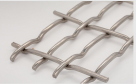
Dutch weave configurations use two mesh count numbers (e.g., 12×64) because the warp and shute wire counts differ. The first number is the warp count; the second is the shute count. Shute wires are packed tightly against each other, eliminating straight-through openings and creating a tortuous filtration path.
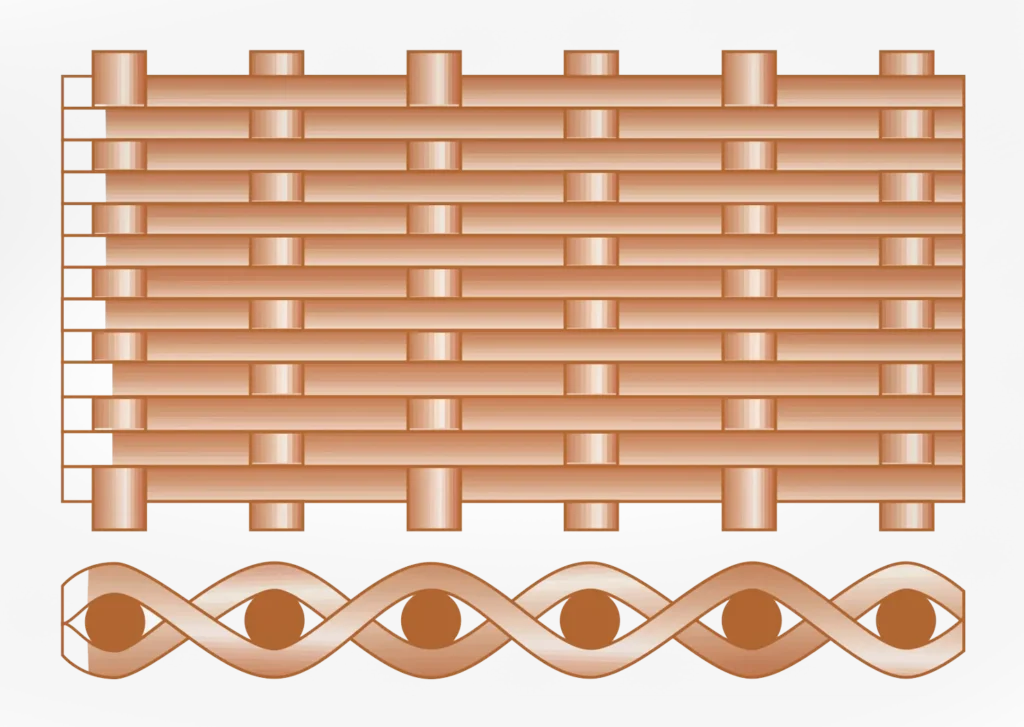
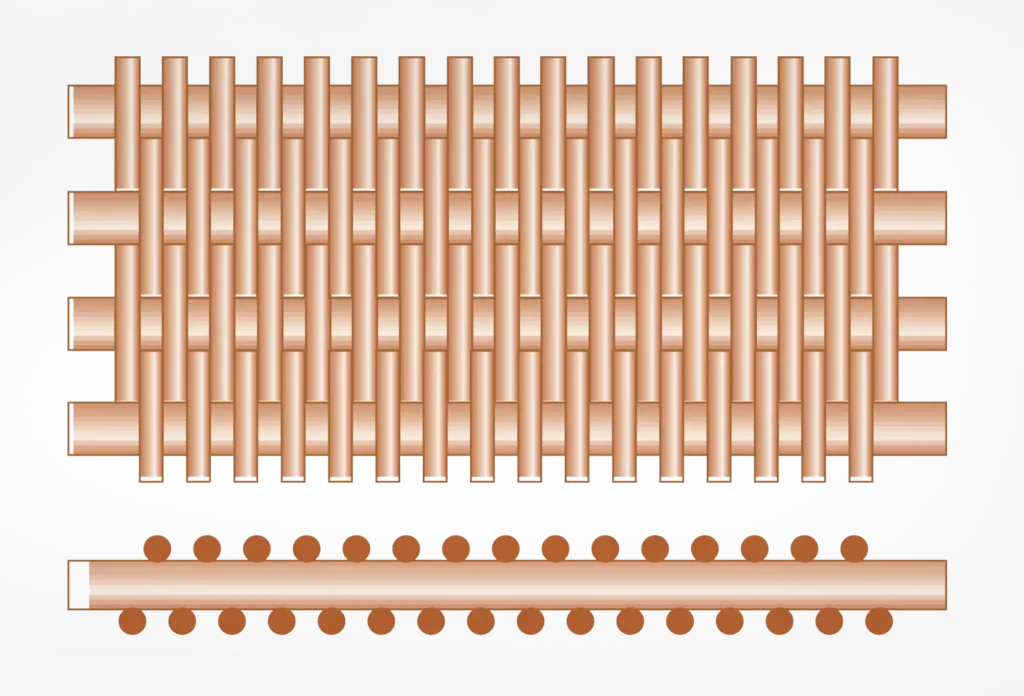
Plain weave is the default for most screening and general filtration. When the application requires retaining particles below 100 microns or operating at elevated pressure, twill and Dutch weaves become the better specification.
Step 4: Select the correct wire diameter
Wire diameter is the variable most engineers underestimate. For any given mesh count, wire diameter controls opening size, open area, and mechanical strength simultaneously. Thicker wire occupies more space in the weave, shrinking the opening between wires and reducing flow — but producing a stronger, more durable cloth. Thinner wire does the opposite.
A heavier wire diameter at the same mesh count gives you a tougher cloth with smaller openings and lower flow capacity. A lighter wire opens up passage and throughput but sacrifices structural integrity.
Standard wire diameters are published in ASTM E2016 for each mesh count. But standard is not the only option. CWC weaves wire cloth with custom wire diameters when the standard opening size or strength does not meet the application requirement.
Consider a 100-mesh specification. With a standard 0.0045″ wire diameter, the opening is approximately 140 microns. Switching to a 0.0040″ wire at the same 100-mesh count increases the opening to 152 microns — a 9% increase in particle passage — while reducing wire cross-section by approximately 21%, with a corresponding reduction in cloth strength.
That engineering judgment, balancing retention, flow, and durability against wire diameter, is where specifications move from generic to application-specific.

Step 5: Consider your material and operating environment
Mesh count and weave type define the filtration geometry. The alloy defines whether that geometry survives the operating environment.
Temperature, chemical exposure, and abrasion are the three variables that drive alloy selection. A 200-mesh cloth specified in 304 stainless steel will fail in a chloride-rich environment where 316 stainless or Monel is required.
Material selection for filtration wire cloth
| Alloy | Max Service Temp | Corrosion Resistance | DFARS Compliant | Typical Applications |
|---|---|---|---|---|
| 304 Stainless Steel | 1,500 F | General — not chloride environments | Yes | General industrial filtration, food processing, water treatment |
| 316 Stainless Steel | 1,600 F | Good — handles chlorides, marine | Yes | Chemical processing, marine, pharmaceutical |
| 316L Stainless Steel | 1,600 F | Good — superior weld corrosion resistance | Yes | Welded filter assemblies, pharmaceutical |
| Monel 400 | 1,000 F | Excellent in seawater, HF acid | Yes | Seawater filtration, chemical processing |
| Inconel 600 | 2,150 F | Excellent at high temperature | Yes | High-temperature exhaust filtration, heat treating |
| Hastelloy C-276 | 1,900 F | Superior — severe corrosion environments | Yes | Severe chemical exposure, flue gas desulfurization |
CWC stocks and weaves all six alloys above plus titanium, molybdenum, tungsten, and over 20 additional specialty alloys. For alloy data sheets and availability, see the raw materials page.
For aerospace and defense applications, DFARS compliance and AS 9100D certification are non-negotiable procurement requirements. CWC holds both.
Step 6: Verify against ASTM E2016 tolerances
Most specification guides skip this step. ASTM E2016 defines the wire cloth specification. ASTM E2814 defines verification and testing methodology for filter cloth. Together, ASTM E2016 (Standard Specification for Industrial Woven Wire Cloth) and ASTM E2814 (Standard Specification for Filter Cloth, Wire, Woven) define permissible manufacturing tolerances for mesh count, wire diameter, and opening size.
Those tolerances matter because a “100-mesh” cloth from one manufacturer may not be identical to a “100-mesh” cloth from another. ASTM E2016 allows specific percentage deviations in mesh count, wire diameter, and opening — and those deviations compound.
Why tolerances matter
A wire cloth specified at 100 mesh with 0.0045″ wire has a calculated opening of 0.0055″ (140 microns). If the actual mesh count varies within the ASTM-permitted tolerance, and the wire diameter simultaneously varies within its own tolerance, the actual opening size may differ from the calculated value.
For general industrial filtration, this tolerance band is acceptable. For pharmaceutical filtration, aerospace hydraulic systems, or any application where out-of-spec media means product contamination or system failure, verification against ASTM E2016 tolerances is a specification requirement.
How CWC verifies
CWC tests incoming wire and finished cloth against ASTM E2016 and ASTM E2814 standards. Mesh count is verified per ASTM E2814 methodology. Wire diameter is confirmed via calibrated micrometers. Opening size is calculated and verified against allowable tolerances.
This testing is routine at CWC — it has been part of the manufacturing quality system since before the current ASTM standards were published. For aerospace wire cloth, all testing falls under the AS 9100D quality management system with full traceability from raw wire to finished cloth.
CWC operates the looms. We know where tolerances tighten and where they do not, because we hold them every day.
Common mesh count ranges by application
The following table maps typical mesh count specifications to common industrial filtration applications. These are starting points — final specifications depend on the specific particle retention requirement, flow rate, pressure, temperature, and chemical environment.
| Industry | Application | Typical Mesh Count | Weave Type | Recommended Alloy |
|---|---|---|---|---|
| Aerospace (AS 9100D traceability required) | Hydraulic fluid filtration | 200-325 (or Dutch weave 325×2300) | Twill Dutch | 316L Stainless |
| Pharmaceutical | API powder sifting | 60-200 | Plain or Twill | 316L Stainless |
| Food & Beverage | Flour and ingredient sifting | 40-80 | Plain | 304 Stainless |
| Chemical Processing | Catalyst recovery | 100-200 | Plain Dutch | 316 Stainless / Hastelloy |
| Water Treatment | Intake screening | 20-80 | Plain | 304 or 316 Stainless |
| Mining | Slurry dewatering | 30-100 | Plain or Twill | 304 Stainless |
| Oil & Gas | Sand control / produced water | 100-250 (or Dutch weave) | Reverse Dutch | Monel / 316 Stainless |
| Laboratory | Test sieve analysis (ASTM E11) | 18-400 | Plain | 304 Stainless |
| Plastics Extrusion | Polymer melt filtration | 20-325 | Plain Dutch / Twill Dutch | 316 Stainless |
| Pulp & Paper | Stock screening | 40-100 | Plain | 316 Stainless |
When a standard mesh count and wire diameter combination does not meet your specification, CWC weaves custom configurations. Request a quote with your application details and target particle retention, and our engineering team will recommend the mesh count, weave type, wire diameter, and alloy combination that fits.
FAQ: Wire cloth mesh count for filtration
Mesh count is the number of openings per linear inch of wire cloth. Micron rating is the size of those openings measured in micrometers. A higher mesh count produces smaller openings (lower micron rating), but the exact micron rating depends on wire diameter. Two cloths with the same mesh count but different wire diameters will have different micron ratings. Always specify both mesh count and wire diameter — or specify the target micron rating directly.
Use the formula: Opening (microns) = (25,400 / mesh count) – wire diameter (microns). For example, a 200-mesh cloth with 0.0021″ (53.3-micron) wire has an opening of (25,400 / 200) – 53.3 = 73.7 microns. CWC’s online calculators perform this conversion for any mesh count and wire diameter combination instantly.
Water treatment intake screens typically use 20- to 80-mesh plain weave wire cloth in 304 or 316 stainless steel, depending on water chemistry. Finer water filtration applications — municipal polishing, industrial process water — may require 100- to 200-mesh or Dutch weave configurations. The specific mesh count depends on the particle size that must be retained and the required flow rate.
Wire diameter determines the opening size for a given mesh count. At any fixed mesh count, a thicker wire reduces the opening between wires (finer retention, lower flow) and produces a stronger cloth. A thinner wire increases the opening (coarser retention, higher flow) but reduces mechanical strength and durability. Wire diameter and mesh count together define the filtration specification.
Nominal micron rating indicates the particle size at which a specified percentage (typically 60-98%) of particles are retained. Some particles smaller than the nominal rating pass through. Absolute micron rating identifies the largest particle that can pass through the media under test conditions, retaining 99.9%+ of particles at the stated size. For critical applications — pharmaceutical, aerospace, semiconductor — absolute ratings are required. For general industrial filtration, nominal ratings are standard.
Open Area % = [(opening / (opening + wire diameter))^2] x 100. For a 100-mesh cloth with 0.0045″ wire and 0.0055″ opening: OA = [(0.0055 / (0.0055 + 0.0045))^2] x 100 = 30.25%. Open area directly affects flow capacity. CWC’s calculators compute open area for any mesh count and wire diameter.
ASTM E2016 (Standard Specification for Industrial Woven Wire Cloth) is the governing specification for wire cloth mesh count, wire diameter, opening size, and manufacturing tolerances. ASTM E2814 (Standard Specification for Filter Cloth, Wire, Woven) covers Dutch weave filter cloth specifically. CWC manufactures and tests against both standards as part of its quality management system.
Yes. CWC weaves custom mesh counts, wire diameters, and weave configurations when standard specifications do not meet the application requirement. Custom wire cloth is common in aerospace, pharmaceutical, and specialty chemical filtration where off-the-shelf mesh count and wire diameter combinations produce the wrong opening size or insufficient strength. Contact CWC with your target particle retention, flow requirements, operating environment, and alloy preference.
Conclusion
Mesh count selection for filtration depends on six variables working together: particle retention, flow rate, weave type, wire diameter, alloy, and standards verification. The mesh count that retains the right particle at the right flow rate in the right chemical environment is the specification worth building.
Cleveland Wire Cloth has been weaving filtration media to exact specifications since 1914, from 5-micron Dutch weave filter cloth to coarse screening mesh. If you have a particle retention requirement, a flow rate target, or an application that needs engineering support, request a quote and our team will help you specify it.