


A worn wire mesh screen does not announce itself. It degrades gradually. Throughput drops, oversized particles slip through, and by the time the line stops, the cost is already compounding. In mining and heavy industrial operations, unplanned downtime averages $187,500 per hour (Senseye/Siemens, The True Cost of Downtime, 2022). Across the mining industry, that adds up to an estimated $15 billion in annual downtime costs (GlobalData).
The five signs that indicate wire mesh screen replacement is needed:
- Visible wire breakage or separation
- Oversized particles passing through the screen
- Drop in throughput or flow rate
- Visible corrosion or discoloration
- A product contamination event
Industrial wire mesh screens are consumable components in vibrating screen decks, filtration systems, and separation equipment across mining, aggregate, food processing, and chemical operations. Screen media lifespan varies widely: 3 to 12 months in mining, 6 to 18 months in general industrial use, and up to 20 to 30 years for stainless steel wire cloth in mild environments. Wire mesh screen replacement timing depends on application severity, the abrasiveness of the material being processed, and whether the original screen was correctly specified for the operating conditions. Cleveland Wire Cloth, a wire cloth manufacturer operating since 1914 with AS 9100D and DFARS certifications, has built and specified screens for every application on this list. The difference between a screen that fails on schedule and one that fails prematurely is almost always the specification, and only a manufacturer can diagnose the root cause.
Why timely screen replacement matters
Manufacturing downtime runs between $50,000 and $260,000 per hour depending on the operation (Senseye/Siemens, The True Cost of Downtime, 2022). Replacing a screen during a scheduled maintenance window costs a fraction of an emergency shutdown.
Delaying replacement accelerates damage to surrounding equipment. Worn screens allow oversize material into crushers and conveyors not designed to handle it. The screen replacement that costs hundreds of dollars becomes a repair bill in the thousands.
Sign 1: Visible wire breakage or separation
Broken wires at weave intersections are the most obvious indicator that a wire mesh screen has reached end of life.
A single broken wire may result from localized impact damage — a tramp metal strike or a bolt that fell through the feed. That is a repair candidate if the surrounding mesh is within tolerance.
A pattern of breaks tells a different story. Multiple wires failing along the same axis, or breaks concentrated at the same position across the deck, indicate a specification problem. The wire diameter may be too thin for the vibratory force acting on the screen.
Look for individual wire breaks vs. repeating break patterns, breaks concentrated at tensioning points (hook strips, bar and tension rails), wire separation at crimp intersections, and wires that have pulled free from the weave.
Warp vs. shute break diagnosis: The direction of the broken wires provides diagnostic value. Warp wires run in the longitudinal (machine) direction. Shute wires run in the lateral (cross) direction. A concentration of warp wire breaks indicates tension-related stress — over-tensioning during installation, or fatigue from sustained longitudinal loading. A concentration of shute wire breaks indicates vibratory or lateral stress acting on the screen. When breaks cluster predominantly in one direction, that pattern narrows the root cause: tension-related failure (warp) or vibration-related failure (shute). This distinction directly informs whether the corrective action involves retensioning procedures, vibration dampening, or a specification change.
If breaks follow a pattern, replacing the screen with the same specification will produce the same failure. That screen needs to be re-specified.
Sign 2: Oversized particles passing through the screen
This is the most operationally visible symptom. The downstream process or the customer catches it first.
When a wire mesh screen allows oversized particles through, the cause is opening enlargement from abrasive wear. Wire diameter reduction means each opening grows incrementally as material flows across the surface. The threshold that triggers replacement is when opening size exceeds the ASTM E2016 tolerance for the specific mesh count and wire diameter combination.
To verify, measure opening sizes with magnification and compare against ASTM E2016 tolerances for the specified mesh count. If openings exceed the permissible tolerance per ASTM E2016, the screen has reached end of service life regardless of visual condition.
Directional wear is common on vibrating screens. The discharge end wears faster than the feed end. Rotating screens 180 degrees at mid-life can extend useful lifespan, but once openings exceed tolerance at any point, replacement is required.
Sign 3: Drop in throughput or flow rate
Throughput decline has two primary causes: blinding and pegging.
Blinding occurs when fine particles wedge into screen openings and progressively seal them shut. Pegging happens when near-size particles lodge in openings and stay there. Both reduce the effective open area and restrict material flow.
Deblinding systems (ball decks, nylon chains, ultrasonic devices) manage these conditions during operation. When deblinding no longer restores throughput, the screen needs replacement. For example, switching from plain weave to pre-crimped wire cloth on a 4-mesh screen handling minus-1-inch aggregate has demonstrated 30-40% open area improvement. Woven wire cloth on high-vibration decks can achieve greater open area than alternative screen media such as polyurethane or rubber panels, allowing higher throughput at equivalent particle separation and translating to higher separation efficiency.
Before replacing, confirm deblinding equipment is operational, feed rate has not changed, openings are within ASTM E2016 tolerance, and the screen has been cleaned per recommendation. If all four check out and throughput is still below target, replace the screen.
Sign 4: Visible corrosion or discoloration
Not all corrosion means the screen has failed. Surface discoloration on carbon steel wire is expected in humid environments. Pitting corrosion, intergranular corrosion, or visible wire thinning from chemical attack is a different condition. The wire cross-section has been reduced and load-bearing capacity is compromised. That screen must come off the deck.
Dissimilar metal corrosion is a common and preventable cause of premature failure. A stainless steel screen mounted in a carbon steel frame creates galvanic corrosion at the contact points. 304 stainless in chloride-rich environments develops pitting (should have been 316), and high-carbon steel in wet processing corrodes without adequate drainage.
Corrosion within expected service life almost always indicates a specification error. Replacing the screen with the same alloy will repeat the failure. When 316 fails in high-temperature chloride or acidic environments, escalate to Hastelloy C-276 or titanium. CWC weaves in both alloys.
Sign 5: A product contamination event
A product contamination event is the most severe indicator. It carries regulatory and financial consequences that extend well beyond the cost of the screen.
In October 2021, Flowers Foods recalled Tastykake branded products after metal mesh wire fragments were found in packaged food items (FDA, October 31, 2021), a failure tracing directly to screen media integrity. The FDA maintains defect action levels (DALs) for metal contamination. Any contamination event triggers immediate investigation, and consequences scale with the volume of affected product.
Any contamination event requires immediate screen removal, root cause analysis (mechanical failure vs. specification error), inspection schedule review, and verification of replacement screen certifications and traceability.
Cleveland Wire Cloth holds AS 9100D certification and DFARS compliance, with full material traceability to ASTM E2016 and ASTM E2814 standards. These certifications exist for applications where screen failure creates contamination risk.
Why screens fail prematurely: a manufacturer’s perspective
The five signs above tell you when to replace. The question a manufacturer asks is why did this screen fail when it did?
If a screen fails repeatedly before reaching its expected service life — especially when comparable installations achieve longer service — the problem is the specification, not the screen. Cleveland Wire Cloth has been weaving wire cloth since 1914, and the pattern is consistent: premature failure traces back to one of four root causes.
Root cause 1: Wrong wire diameter
Wire diameter is a tradeoff. Too-thin wire increases open area percentage but reduces abrasion resistance and fatigue life. The screen develops a predictable break pattern as fatigue cycling accumulates. Too-thick wire reduces open area, causing blinding and pegging under normal operating conditions. The screen looks intact but stops doing its job.
The correct wire diameter balances open area against the abrasive and vibratory forces in the specific application. This requires understanding the particle size distribution, feed rate, and vibration profile of the screen deck.
Root cause 2: Incorrect crimp style
Crimp style determines how wires behave under vibration.
- – Pre-crimp is a flat, stable panel suitable for moderate vibration.
- – Lock crimp locks wires at each intersection. It prevents movement but may be too rigid for high-frequency vibration, causing fatigue cracking.
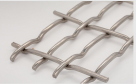
- – Double crimp places two crimps per intersection, giving maximum resistance to wire chatter and opening distortion under heavy vibration.
Specifying pre-crimp for a high-vibration mining deck is a common error. The screen will chatter, openings will distort, and wires will fatigue in months.
Root cause 3: Wrong alloy
Sign 4 (corrosion) is often a specification error rather than a wear condition. 304 stainless steel in a chloride environment will pit. Carbon steel in a wet acidic environment will corrode. These are predictable failures based on known material properties.
Alloy selection must account for the chemical environment, operating temperature, and abrasive characteristics of the feed material. A stainless steel grade comparison is the starting point, but CWC’s engineering team regularly specifies beyond the standard grades when the application demands it.
Root cause 4: Incorrect mesh count
When the mesh count is too close to the dominant particle size in the feed, near-size particles lodge in the openings. This is the pegging problem described in Sign 3.
The fix is not always a finer mesh. Adjusting mesh count requires analyzing the full particle size distribution, including the percentage of near-size particles that create pegging conditions. This is specification engineering, and it requires a manufacturer’s involvement.
Repair vs. replace vs. re-specify
Scope note: CWC manufactures wire cloth. CWC does not perform field repairs or rescreening. In this section, “Repair” refers to the end user’s maintenance decision. CWC’s role begins at “Replace” (manufacturing the same specification) or “Re-Specify” (engineering a corrected specification).
Most screen replacement articles treat the decision as binary — is the screen worn out or not? That misses the third option.
Repair
Minor localized damage — a single impact hole, a broken wire at a tensioning point — can sometimes be patched if the surrounding screen section measures within tolerance. Rescreening — installing new wire cloth on existing frames — typically costs less than a full new screen purchase (industry estimates suggest 30-40% savings, though actual savings depend on frame condition and labor costs), with typical turnaround of 1 to 3 days.
Repair makes sense when damage is localized, surrounding mesh is within ASTM E2016 tolerance, the screen has substantial remaining service life, and no contamination risk exists.
Replace
Replace with the same specification when the screen has reached its normal end of service life and wire diameters have worn below tolerance uniformly.
Screen lifespan by application:
| Application | Typical Lifespan | Material |
|---|---|---|
| Mining / aggregate (vibrating deck) | 3 – 12 months | High-carbon steel, stainless steel |
| General industrial screening | 6 – 18 months | Stainless steel, carbon steel |
| Mild / non-abrasive environments | 20 – 30 years | Stainless steel |
If the screen reached these ranges before failure, the specification was correct. Replace it with the same product.
Re-specify
Re-specify when screens fail before reaching expected service life. If a screen fails repeatedly before reaching its expected service life — especially when comparable installations achieve longer service — the problem is the specification, not the screen.
A distributor can sell the same screen again. A manufacturer like Cleveland Wire Cloth can analyze the failure mode and redesign the specification: adjust wire diameter, change crimp style, select a different alloy, or modify mesh count to eliminate the root cause.
Consider re-specification when the screen fails in less than half its expected service life, the same failure mode repeats across multiple screen changes, operating conditions have changed since the original specification was written, or contamination events have occurred.
Request a consultation with CWC’s engineering team to review screen performance data and develop a revised specification.
How to establish a proactive replacement schedule
A proactive schedule based on inspection data and historical screen life eliminates unplanned downtime.
Inspection frequency
| Application Severity | Inspection Interval |
|---|---|
| Heavy-duty (mining, aggregate, high-abrasion) | Once per shift |
| Moderate (general industrial, chemical processing) | Weekly |
| Light (mild environments, low abrasion) | Monthly |
| Minimum for all vibrating screen applications | At least once per quarter |
Manufacturer’s inspection checklist
Measure wire diameter with a micrometer at 3 to 5 points across the screen surface. Verify opening size against ASTM E2016 using a light box and magnification. Check mesh count accuracy by counting wires per linear inch at multiple locations. Inspect for visual damage including wire breaks, separation at crimps, corrosion, and deformation.
You will need a digital micrometer, light box, magnification (10x minimum), and a measurement log.
Reject the screen if wire diameter is below the specified minimum, opening size exceeds the permissible tolerance per ASTM E2016 for the applicable mesh count and wire diameter, any wire breakage pattern is present, any structural corrosion is visible, or any contamination is detected downstream.
Tracking screen life
Record installation date, removal date, and reason for removal on every screen. After 3 to 4 cycles, the data establishes a baseline service life. Screens that consistently fall short warrant re-specification.
FAQ: Wire mesh screen replacement
Heavy-duty operations (mining, aggregate) require inspection once per shift. General industrial applications call for weekly inspection. Light-duty environments need monthly checks. At minimum, every vibrating screen application should be inspected at least once per quarter.
The primary factors that determine screen lifespan are abrasion intensity of the feed material, chemical exposure and operating temperature, vibration frequency and amplitude, whether the screen was correctly specified for the application, and the wire diameter-to-opening ratio. In practice, these factors produce wide ranges: mining and aggregate vibrating screen decks typically see 3 to 12 months, general industrial screening 6 to 18 months, and stainless steel in mild, non-abrasive environments can last 20 to 30 years.
Minor localized damage can sometimes be repaired if surrounding mesh measures within ASTM E2016 tolerance. Rescreening — installing new wire cloth on existing frames — typically costs less than a full new screen purchase (industry estimates suggest 30-40% savings, though actual savings depend on frame condition and labor costs). Repair is not appropriate when damage follows a repeating pattern, openings exceed specification, or contamination risk exists.
Four root causes account for most premature failures: wrong wire diameter (too thin causes fatigue breakage, too thick causes blinding), incorrect crimp style for the vibration profile, wrong alloy for the chemical environment, and incorrect mesh count for the particle size distribution. If screens consistently fail early, the specification — not the screen — is the problem.
Thinner wire increases open area and throughput but reduces resistance to abrasion and fatigue. Thicker wire is more durable but reduces open area, which can cause blinding and pegging. The correct diameter depends on the vibratory forces, feed material abrasiveness, and target opening size for the application.
316 stainless steel is the standard choice for chloride-rich or mildly acidic environments where 304 stainless would develop pitting corrosion. For highly aggressive chemical environments, Hastelloy and Inconel provide greater corrosion resistance than 316 stainless in highly aggressive chemical environments. Alloy selection must account for the specific chemicals, temperatures, and pH levels present.
Screen blinding occurs when fine particles wedge into mesh openings and progressively seal them, reducing effective open area. Blinding directly reduces throughput and separation efficiency. Deblinding systems (ball decks, nylon chains, ultrasonic devices) manage the condition during operation but cannot reverse permanent material buildup. When deblinding no longer restores performance, replace the screen.
Measure wire diameter with a calibrated micrometer at multiple points across the screen surface. Verify opening sizes using a light box and magnification, checking against ASTM E2016 tolerances. Count mesh per linear inch at several locations to detect distortion. A variance exceeding the ASTM E2016 tolerance for the specific mesh count and wire diameter combination indicates end of service life.
When to act
Wire breakage, oversized particles, throughput decline, corrosion, and contamination all point to a screen that needs attention. The root cause analysis tells you whether to replace it with the same specification or redesign it. Cleveland Wire Cloth has been manufacturing woven wire mesh since 1914. Request a quote or contact our engineering team to review your screen specification.